Showing posts with label book review. Show all posts

Friday, May 23, 2014

A Big Blue Dick: A Review of Clown Tear Junkies by Douglas Hackle

This is that painting by Munch, The Scream


Do you know that painting The Scream by Edvard Munch? Okay, now imagine that that character there in the foreground is real, and he’s called The Scream, and he doesn’t talk or make any noise at all, and he usually keeps his wavy hands next to his gaunt face unless he’s doing something else with them. And he hangs out with an immature, blue-collar jerk who takes him clubbing all the time, trying to pick up chicks. And the chicks all think the Scream’s friend is a loser, but that’s okay, because he’s got a pat response that puts them all in their place: he tells them they are 7s. Then goth chicks start to dig The Scream and he becomes a horror movie star, so the two part ways….

That’s pretty much what it’s like inside Douglas Hackle’s mind all the time.

And that’s pretty much the story The Scream, My Dog, part of Hackle’s collection Clown Tear Junkies. I spoilered the crap out of it, but you should still read it because it’s still good.

Camera zooming out for a moment, Clown Tear Junkies (WARNING: Contains zero clowns and/or circuspunk elements) is a collection of 27 very short stories. People like to use the term “absurd” to refer to this style of prose, and while some of it is absurd, Hackle’s style is much more nuanced. He draws equally from the wells of the existentially absurd turf mined by Kafka (see: Struggle of a Description); the playful, list-loving postmodernism of Barthelme; and obscure pop cultural references—Stiles from Teen Wolf makes an appearance alongside the chain-smoking Indonesian toddler of YouTube fame. What makes Hackle’s writing so much fun is his unpredictable wordplay and his juxtaposition of low brow fare and academic trivia. You’ll find quite a bit of recursive humor tying the stories together, not the least of which will be the intoxicating and addictive nature of clown tears (esp. when mixed with mime tears and mainlined—what a rush!). You’ll find yourself looking up words to see if they are in the real dictionary or at urbandictionary.com (yes, both chyme and chyle are for real). You’ll find yourself expecting the stories to be going in one direction; you’ll be surprised where they end up taking you.  

Now, there are a few moments when the stories just get downright silly, and there’s probably a story or two that doesn’t stack up to the rest of the collection. But 27 is a nice round number, and who are you to tell Hax to the Max to drop a story from his baby? I mean, these stories are like his children, and just because some of them are born with beards or flippers or lobster faces doesn’t mean you love them any less, right? Are you asking the man to pick his favorite child? What kind of a monster are you? Quit Sofie-ing his choice! When you do see one of these freak babies, do not make direct eye contact. Just keep your head down and push through to the next paragraph, which is bound to be creepily brilliant, like Crispin Glover playing Sherlock Holmes.

And there are a few moments where you think to yourself, “Is Douggie Hacksaw trying to tell me something?” It’s possible some of the stories actually have a meaning. Racism, homosexuality, intimacy, education, cosmology, music, art, life and death, puppets/poppets, chyme and chyle are all examined in varying degrees of insanity. At the end of the book, I learned that Strange House advertises within Rooster Republic books, and this seemed like a sort of conflict of interests, but nowadays networks advertise their shows on other networks, so whatever. It just makes it harder to remember which station the shows come on, but I have a TiVo, which doesn’t seem to get confused and can always figure out how to record the shows I tell it to.

I’d point out the highlights, but that’s almost the entire book. If I can only recommend three of these stories to strangers, I’d say that you, stranger, should start with The Perfect Popcorn: A Recipe, Fishing with Higginsworth Fig VII: A Tale of Denial, and Give Courtney Cute Anything She Wants.

The Scream, My Dog could really act as a sort of synecdoche here. Meaning, I could say, “You read The Scream, My Dog yet?” and you would understand that I meant, “Have you read Clown Tear Junkies by Dig Doug Hackensplatz yet?” We just have that kind of understanding of each other, don’t we, stranger?

Wait, forget it. Just read the whole damn book. We’re done here.


Sunday, February 24, 2013

Lucky Number 13

Kitten just received its 13th 5-star review on Amazon (including that delightful one by R.A. Harris on Amazon UK).  Tamara Romero, author of the exquisite Her Fingers, was the benevolent woman who pushed the number to the threshold of the weird, the number 13. 

Here's the review:

Trust the buzz, adopt the Kitten, because what everybody says about it is true. This is the story of a silly kid -like most children- that can't even understand that his kitten is not a kitten. His pet is a lovely, upright and adventurous thing that vomits coloured stamps. The boy's mom is an evil woman who wants to get rid of the kitten. Oh boy, they have enough trouble at home. Her life is already too complicated. So the kitten will end up in the hands of the Collector and travel to the Steel Planet. Luckily you always make new friends when you travel around, and so does the kitten. He will get a name, a decent cat condition and lots of hanging out with a knight with fish-hands. All this sounds crazy, I know, but G. Arthur Brown will take your hand and drive you smoothly so you don't faint. My personal highlight is a very particular retelling of children stories: the pee baby. We want more pee baby stories, G.

Thanks, Tamara!

Trust the buzz!

Buy Kitten now (also for Kindle). 

Friday, December 21, 2012

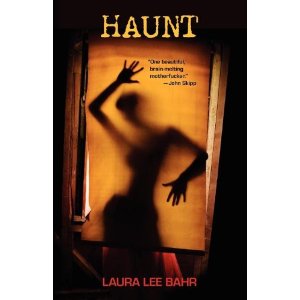
Review: Haunt by Laura Lee Bahr

Haunt by Laura Lee Bahr.

You Don't Know What This Book Is

You don't know why you bought this book. (I met Laura Lee Bahr, but you didn't, so why did you buy it? It's a mystery.)

You start reading this book. You don't know what it is. But you can't put it down. It's like being led by the nose. It's like being in love. You keep reading in hopes you can figure it out.

But then you give up trying to figure it out, because there is no way to figure out magic, and you just enjoy the ride, enjoy being led by the nose. The book smells great, by the way, so you don't mind. Once all is said and done, it's one of your favorite books ever. If you are ever remotely cool, that is.

So, if you are even remotely cool, you should buy this book. And then you have the excuse that I told you to buy it, and you won't have to wonder so much. 

Saturday, January 7, 2012

New Bizarro Author Reviews I: Placenta of Love by Spike Marlowe


I'm going to do reviews of all eight of 2011's books by the New Bizarro Author series. Mainly I am doing this because I hope to join their ranks in 2012. But also because the books are all damn good and deserve as much publicity as can be mustered (mustard?).

We begin with Placenta of Love by Spike Marlowe. This is the tale of a Robo Pirate who goes in search of love, creating for himself a lover that goes all Frankenstein and causes major problems for the dude. On it's face a fairly simple but weird fantasy romance with thrilling resolve. But on further examination the story is anything but simple.

Spike Marlowe (who is a woman, despite the masculine ring of the fictitious first name) brings a uniquely feminine voice to the Bizarro movement without being in any way girly. I find that many male readers are turned off by 'feminine' writing because they assume it is girly lit, which is hardly the case with Placenta of Love. Little girls in their pink princess gowns aren't going to be sitting at tea party tables, a star tipped wand in one hand, a copy of Placenta in the other, reading it and doing all the various voices (cat, pirate, placenta, et al) in hilarious tones that their mothers can video and submit to a show that rewards hilarious video moments. Ironically, the color pink and faeries do figure into the story prominently.

For those of you wondering what the story is about, I guess a short synopsis is in order. The blurb on amazon goes:

Step right up! Captain Carl the robo-pirate is one of the few Artificial Intelligences living on Venus-the amusement park planet. When Carl is given the spark of intelligence by his creator, he becomes a creator himself. No longer just an automaton from a pirate ride, Captain Carl creates the love of his life and searches for her perfect body. He thinks he's found it in a big placenta. But programming is everything.

When the placenta's desire to reproduce kicks in, the whole park is endangered as the organ grows to monster size, spreading placenta babies across the planet and eating all the rides (and the people riding them!). Captain Carl must band together with a cat, a creator, and the Pope of The Church of Transubstantial Birth Fear to stop his love from killing everyone and destroying the park.

That's a pretty good plot summary, I must admit, so to redo it in my own words would be a waste of time. It tells you exactly what happens without revealing the exciting finish (Spoiler: the good guys win!). But again, don't mistake this relatively simple story as just sheer light entertainment. There are several truly profound philosophical angles to explore.

i. The Male Protagonist as Portrayed by the Female Author
Dealt with both in a very straight-forward way--we can easily understand Capt. Carl's motivations and weaknesses--and in more subtle terms, the penning of a male protagonist by a female author always brings with it certain philosophical underpinnings, most notably that she believes her audience is predominately male and that males will not read feminine writing because they think it is girly, as I mentioned above. This could be the case with Spike, or it could be that she wishes to dissect the overused male protag to shed a postmodern light on his ridiculous innards. For instance, Capt. Carl desires to create, and he tries to do this by taking the non-sentient automatons of Venus and creating from them sapient AI-driven Robos. The age old notion that men create things because they cannot bear children is well-trod territory. Does Marlowe intend us to suspend our disbelief and swallow this nugget without a grain of salt, or should we see it as a lampooning of a cliched (and frankly, unfounded) notion perpetuated in the patriarchal society we find ourselves in? Viewed honestly, doesn't this notion reduce women to nothing more than baby-makers who are completely satisfied in chasing their biological destiny? More on this in the next section.

ii. The Portrayal of Biological Purpose as Ultimately Destructive
So, Capt. Carl fashions for himself what he believes will be a perfect lover: a living placenta with an implanted AI. His new creation/lover names herself Helen. Now, Helen consists of two (contradictory)natures: the rational and sympathetic AI, the carnal and self-serving biological nature. In contrast, Carl is motivated by his AI without the hindrances of the flesh. Helen can't wait to have sex, which Carl doesn't seem to really comprehend, and once Helen becomes pregnant for the first time with Carl's progeny she desires the feeling of 'fullness' that this experience gives her, despite her pregnancies only seeming to last for a few minutes. So, her thirst to produce more and more offspring is unslakeable. She has seemingly no concern for all these placenta-babies that she is creating, only caring that she can remain pregnant for as much of the time as possible. Is this a metaphor? It's hard to see it as anything but.

iii. Inconsequential Offspring

In the course of her rampage, Helen creates hundreds of placenta-babies, which she immediately abandons. Carl is only concerned with stopping Helen's path of mayhem; in order for Helen to become "pregnant" she must absorb an object or person to impregnate her. Carl is not concerned with the offspring, all of which he orders destroyed by fire, except for the original offspring he and Helen created together, which he damns to a life of slavery in a side-show exhibit. Another prominent character is the female Pope Natzo Innocent, who creates her own army of Robo servants for the sole purpose of worshiping her. Is this new generation simply to provide new consumers for the corporate machine that is Venus? One may take the guess that Marlowe's attitudes to toward parents is somewhat negative, and that leads us to the next section.

iv. Parental Roles
There are two creative forces on the amusement park planet Venus: Zampanò, the male force that instills intelligence, will, and emotion; and The Lady Fey, who gives all automatons their physical (read as: carnal) form. Are we to understand that the feminine creative force does not elevate and enlighten the souls of her children, but relies on the male for that guidance? I should turn this work over to an expert in feminist theory, because I'm afraid I'm getting out of my depths. Which brings me to:

V. The Stereotypical Presentation of Pirates

Much of cinema and literature has served to degrade the multifaceted and sometimes even noble pirate into a flat, cardboard clown that is often made the subject of fun. Capt. Carl can't abide his pirate nature because it is so restrictive, being confined to cliched lines like, "Avast, me hardies!" and "Shiver me timbers!" He is also portrayed with a hook and a pegleg, the combination of which was relatively rare when piratical history is truly examined. Marlowe seems to be saying it is okay to forget about the generally ecumenical and democratic nature of service aboard pirate ships. We must focus only on the eye-patches. Am I digging too deep here for meaning? I feel that we are not digging nearly deep enough. Because I haven't even touched the fact that she equates cats with femininity, and includes the Japanese picture snapping tourists, and her trivialization of religious institutions as the cults of self-important self-appointed pontificators. If I was a Republican, I would suggest we burn the book, but since I don't believe these Bizarro books can be destroyed by anything less than Hellfire, I shall resist the urge to vote for Mitt Romney.

All in all, a very entertaining book. And yes, it is a first novel, so I did a cut a bit of slack--you can tell it was a bit rushed, but damned if it wasn't thoroughly entertaining. I look forward to her next release and I'm sure it will be even better than this one. Marlowe is going places. If we could only get her to remove her mask and show us her true face...


Next up: Gigantic Death Worm by Vince Kramer.